
With the help of pictures, we have created a food web. The posters can be displayed in classrooms. In ecology, a food web is the network of feeding relationships between species in an ecosystem. Each node in the network represents a species, and the links between nodes represent trophic (feeding) relationships. Food webs are often drawn as diagrams, with species arranged around the periphery and linked to one another by arrows indicating what eats what.
Please download the PDF food web pictures
2. Food Web Chart Downloadable PDF
This PDF layout is in landscape size. You can download the PDF Food Web Chart Printable

3. Food Web Poster
Please download Food Web

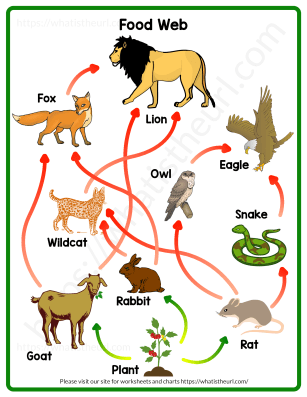
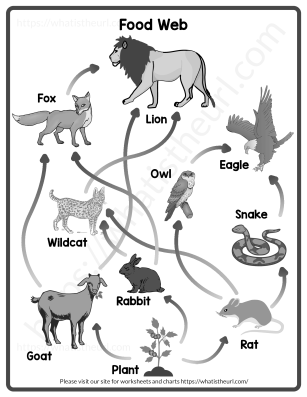
This chart represents a food web, which is a network of interconnected food chains showing how energy flows through an ecosystem. It illustrates the relationships between producers, herbivores, and carnivores.
Key Components of the Food Web:
- Producers (Plants):
- The Green Plant is the primary producer that provides energy for herbivores.
- Primary Consumers (Herbivores):
- Goat and Rabbit eat the green plant, gaining energy.
- Mouse also feeds on plants.
- Secondary Consumers (Carnivores that eat herbivores):
- Wild Cat eats the Rabbit and Mouse.
- Owl preys on the Mouse.
- Snake may eat the Mouse.
- Tertiary Consumers (Carnivores that eat other carnivores):
- Kite preys on the Snake.
- Wild Cat is also eaten by the Lion.
- Jackal and Lion prey on the Goat.
- Top Predators (Apex Predators):
- Lion is at the top of the food web, meaning it has no natural predators in this ecosystem.
Key Takeaways:
- Energy flows from plants (producers) to herbivores (primary consumers) and then to carnivores (secondary and tertiary consumers).
- The presence of multiple predators and prey creates a balance in the ecosystem.
- If one species is removed, it can affect the entire food web.
This food web highlights the interdependence of species and the complexity of nature’s ecosystems.