
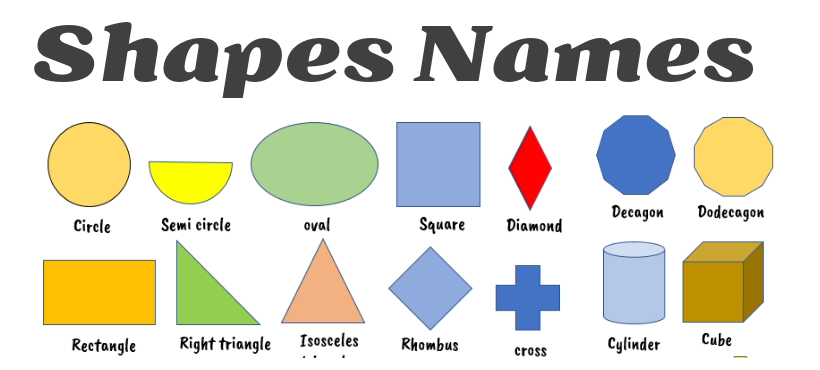
The Half-Circle Shape: A Detailed Explanation
A half-circle is exactly what the name suggests – it is a shape that represents half of a complete circle. It is also called a semicircle. This concept is fundamental in geometry, and it’s useful in many real-world applications, from architecture to design.
Understanding a Circle
To begin with, let’s remember the definition of a circle. A circle is a perfectly round shape where every point on the edge is equidistant from a central point. The distance from the center to any point on the circle is called the radius, and the distance around the circle is its circumference.
When you divide this circle in half along a diameter, you get a semicircle. It’s simply half of the circle, bounded by a diameter and half of the circumference.
Key Characteristics of a Semicircle
- Straight Line: A semicircle always has one straight edge. This straight edge is a diameter of the original circle. The diameter is a straight line that passes through the center of the circle and touches the circle at two points on opposite sides. This is the line that divides the circle into two equal parts.
- Curved Edge: The other edge of the semicircle is half of the curved edge (circumference) of the original circle. This is what gives the semicircle its unique shape.
- Central Angle: The central angle of a semicircle is always 180 degrees (or π radians). This is the angle formed at the center of the circle by the two radii that extend to the endpoints of the diameter.
- Area: The area of a semicircle is half of the area of a full circle. The formula to calculate the area of a full circle is πr² (where r is the radius). So, for a semicircle, the area is:
- Area of semicircle = (1/2) × πr²
- Perimeter: The perimeter of a semicircle consists of the straight line (diameter) plus half of the circumference. The formula for the perimeter is:
- Perimeter = Diameter + (π × Diameter)/2
- Perimeter = d + πd/2
- Perimeter = d(1 + π/2)
- Or, in terms of radius: Perimeter = 2r + πr = r(2 + π)
Geometric Properties of a Semicircle
- Inscribed Angles: Any angle inscribed in a semicircle with its vertex on the semicircle and its sides passing through the endpoints of the diameter is a right angle (90 degrees). This is known as Thales’ theorem.
- Centroid: The centroid (center of mass) of a semicircular region is located at a distance of 4r/(3π) from the center of the original circle along the axis of symmetry.
Applications of a Semicircle in the Real World
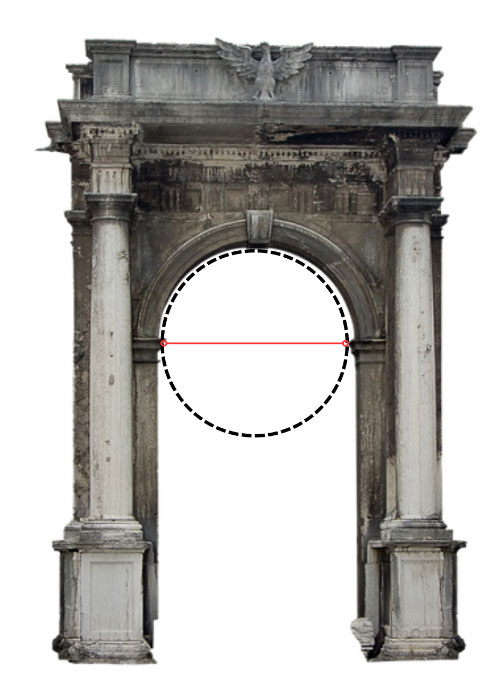
- Architecture: Semicircles are commonly used in architectural designs, especially in arches, windows, and doorways. They provide structural strength and an aesthetically pleasing look. The Roman arch, a semicircular arch, has been a fundamental element in architecture for thousands of years.
- Design and Art: In design, the half-circle shape is often used to create balance or focus within a composition. It’s a popular choice in modern and abstract art, as well as in logo design.
- Engineering and Construction: Semicircular shapes are important in engineering, especially in bridge design, where arches efficiently distribute weight and stress.
- Mathematics and Physics: Semicircles are used in various mathematical proofs and physics problems, particularly in the study of circular motion, waves, and optics.
- Everyday Objects: Many everyday items incorporate semicircular designs, from protractors used to measure angles to the shape of certain furniture pieces.
The half-circle or semicircle is not just a simple shape; it has various mathematical properties and real-world applications. Understanding its geometry helps in a wide range of fields, from mathematics to construction and design.
So, next time you come across a shape that looks like half of a circle, you’ll know that it’s a semicircle, and you can apply the appropriate formulas and properties to work with it effectively.
9 Responses
amazing lot of thanks to you hope to find math for grade 4,5,6
U don’t have all the shapes
Can you please send me the list of shape names? I can create new one,
The shape rhombus is not rhombus, it is a square since it has right angle.
cone
ta bueno
Thank you so much. We are grateful.
Hi
I would like to access your worksheets on shapes 🙂
Thanks
Deb
what are these shapes