25+ Different Ways of Saying "This shows"
Do you want to learn how to say "This shows" in different ways? This post can help you learn about it. In our daily life, at least one time, we have to use "This shows" in conversation, letter writing or in teaching. But saying same sentences can bore people. Using the following other ways can impress your audience. The PDF is available below to download. It contains about 25+ words with examples.
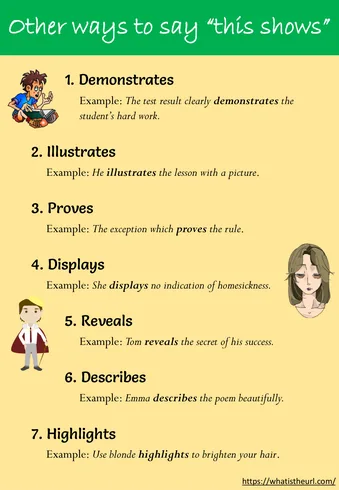
Words on the chart: Demonstrates, Illustrates, Proves, Displays, Reveals, Describes, Highlights, Defines, Illuminates, Clarifies, Exemplifies, Portrays, Emphasises, Encapsulates, Connotes, Depicts, Suggests, Points out, Explains, Confirms, Indicates, Outlines, Exhibits, Establishes, Presents, Points to, Validates, conveys.
We are updating this page with some more examples.
- Demonstrates: The experiment demonstrates the impact of sunlight on plant growth.
- Illustrates: The graph illustrates the upward trend in sales over the last quarter.
- Highlights: The study highlights the importance of regular exercise for overall well-being.
- Reveals: The investigation reveals previously undisclosed information about the case.
- Displays: The artwork displays a striking blend of colors and textures.
- Indicates: The rising temperature indicates a shift in climate patterns.
- Portrays: The novel masterfully portrays the complexities of human relationships.
- Manifests: The enthusiasm of the audience manifests through loud applause.
- Exhibits: The museum exhibits a diverse collection of historical artifacts.
- Signifies: The change in policy signifies a significant shift in company strategy.
- Expresses: The artist expresses emotions through a vibrant use of brushstrokes.
- Conveys: The poem conveys a powerful message of resilience and hope.
- Evokes: The music evokes a sense of nostalgia and longing.
- Unveils: The press conference unveils the latest advancements in technology.
- Discloses: The report discloses key findings from the research study.
- Depicts: The film depicts the harsh realities of life in a war-torn region.
- Presents: The speaker presents a compelling argument for renewable energy.
- Communicates: The logo communicates the brand's commitment to innovation.
- Exemplifies: The success story exemplifies the principles of hard work and perseverance.
- Exposes: The documentary exposes the environmental impact of industrial pollution.
- Unearths: The archaeological dig unearths ancient artifacts from a lost civilization.
- Shows forth: The vibrant colors of the sunset show forth the beauty of nature.
- Represents: The statue represents the spirit of freedom and independence.
- Connotes: The use of specific imagery connotes a sense of mystery in the painting.
- Imparts: The mentor imparts valuable wisdom to the new generation of leaders.
- Suggests: The data suggests a correlation between regular exercise and mental well-being.
- Clarifies: The additional information clarifies the ambiguity in the initial statement.
If you want to use alternative words for "this shows", Please follow the notes.
Using "Illustrates" in an essay
The term "illustrates" is a valuable addition to academic writing, offering a refined alternative to basic expressions such as "this shows" or "this demonstrates." It is particularly effective in conveying how an idea, concept, or argument is supported by evidence, ensuring that the reader can clearly understand the logical connections being made.
In an essay, "illustrates" serves to strengthen explanations by providing concrete examples or detailed analysis. It is especially useful in subjects that require clarity in reasoning, such as literature, social sciences, and scientific research. By using this word, a writer not only presents information but also enhances comprehension, making complex arguments more accessible.
Moreover, the use of "illustrates" helps in maintaining a formal and academic tone while improving the overall coherence of the text. It ensures that the essay remains structured, engaging, and analytically sound.
Demonstrates
The term "demonstrates" is a precise and effective alternative to basic expressions like "shows" or "proves." It is particularly useful in academic writing when presenting evidence, explaining a concept, or establishing a logical argument. By using "demonstrates," a writer conveys not only that something is being shown but also that it is being systematically proven or illustrated with clarity.
In an essay, "demonstrates" is often employed when discussing research findings, analyzing theories, or drawing conclusions based on facts. It strengthens the argument by indicating a well-supported and reasoned explanation, making the writing more authoritative and persuasive. Whether used in scientific discussions, literary analysis, or historical arguments, this word ensures that the reader recognizes the depth of analysis and the logical progression of ideas.
Highlights
The term "highlights" is a precise and effective alternative to commonly used phrases like "this emphasizes" or "this shows." It plays a crucial role in academic writing by directing attention to key points in an argument, ensuring that the reader fully grasps the most significant aspects of the discussion.
Using "highlights" in an essay allows for a structured and refined presentation of ideas. It is particularly useful when discussing critical findings, analyzing literary texts, or presenting arguments in a logical manner. This word conveys not only emphasis but also a sense of clarity, making complex concepts more accessible to the reader.
The word "Reveals" in essays
The term "reveals" is a compelling alternative to common phrases like "shows" or "indicates." It is particularly useful in academic writing when uncovering deeper meanings, presenting new insights, or analyzing hidden aspects of a subject. By using "reveals," a writer conveys that something has been brought to light, emphasizing discovery and critical analysis.
In an essay, "reveals" is especially effective in literary analysis, scientific discussions, and historical interpretations. It suggests that an argument, piece of evidence, or research finding uncovers a previously unnoticed detail or a deeper truth. This term is instrumental in engaging the reader by encouraging them to think critically and explore ideas beyond surface-level understanding.