Metaphor Examples with Meanings
What is a metaphor?
A metaphor says that one thing is another thing. It does not mean this literally — it borrows the second thing's qualities to describe the first.
When we say "My sister is a tornado," nobody thinks she is a spinning column of wind. We mean she moves fast, fills the room, and leaves a mess behind her. That borrowing is the whole trick, and it is why metaphors make writing shorter and sharper: one image does the work of a whole sentence of explanation.
Metaphor or simile? The one-word test
This is the difference almost everyone gets wrong, and it is genuinely simple.
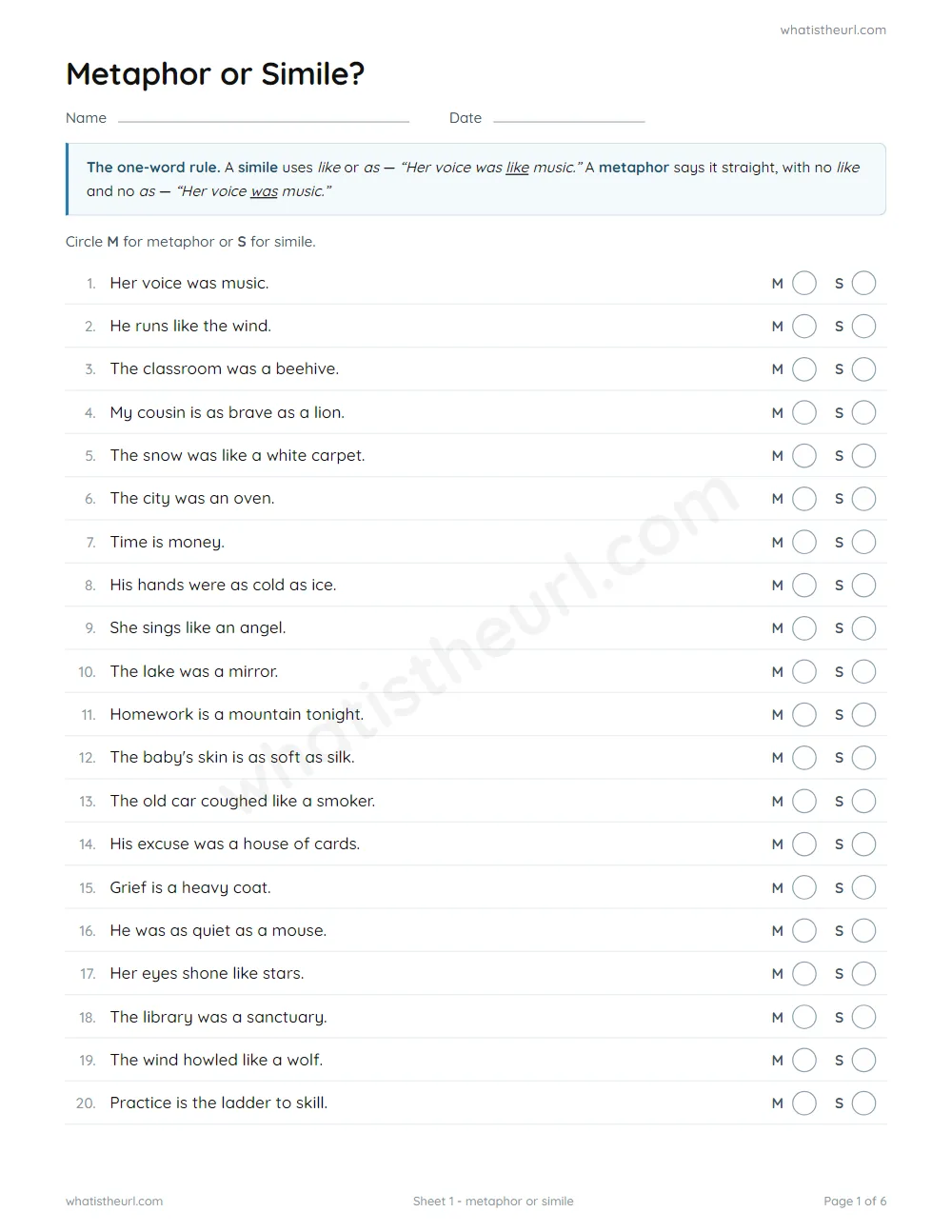
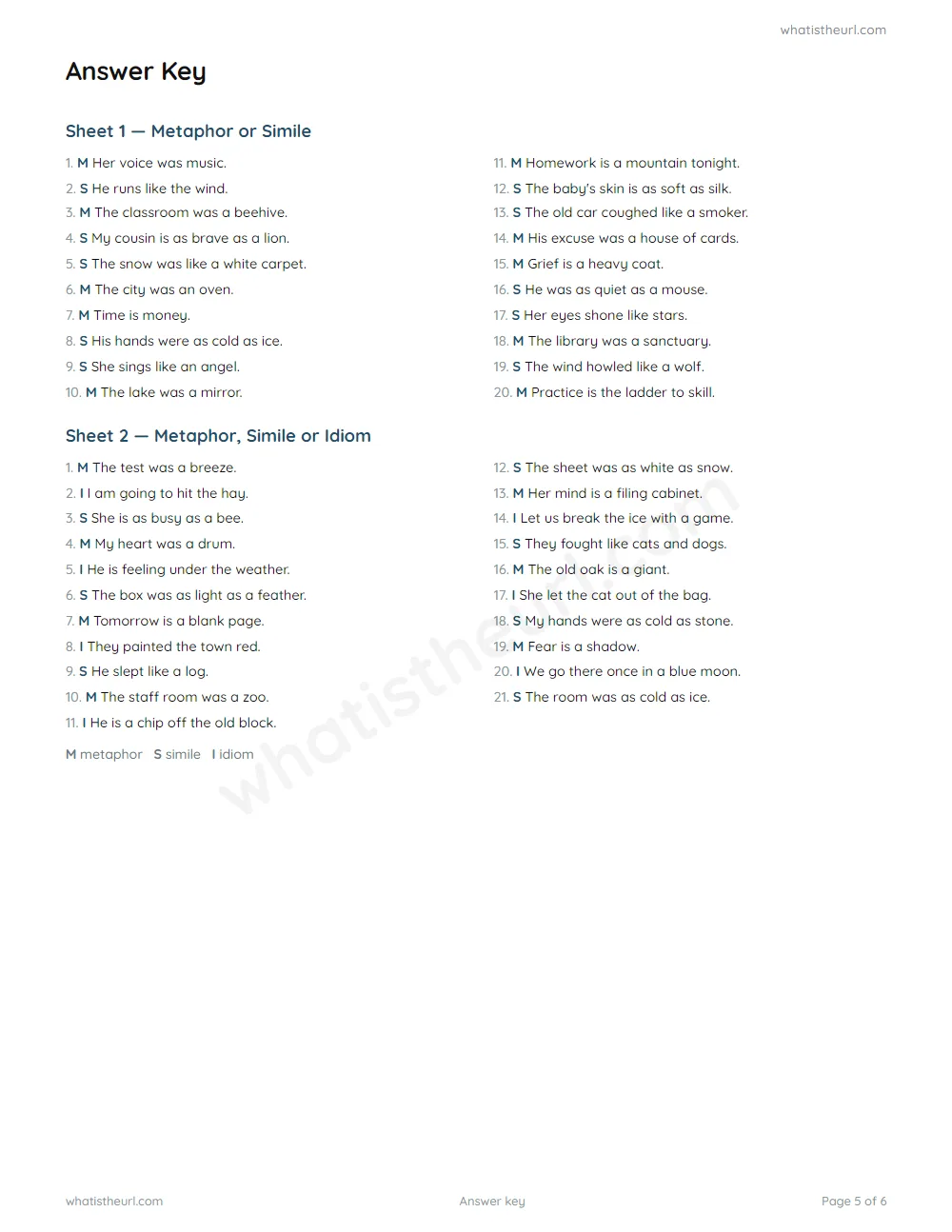
- A simile says something is like something else. It uses like or as. — "Her voice was like music."
- A metaphor says something is the other thing. No like, no as. — "Her voice was music."
Same idea, more force. The simile admits it is a comparison; the metaphor just states it as fact and lets the reader do the work.
Quick test: read the sentence and look for the word like or as. If one is there, it is a simile. If the sentence flatly claims A is B, it is a metaphor.
Metaphor or idiom? The difference that matters
Many lists of "metaphor examples" are quietly full of idioms. They are not the same thing, and teaching them as the same is what leaves students confused later.
An idiom is a fixed phrase whose meaning you simply have to know. You cannot work it out from the words, and you cannot change the words. "Hit the hay" means go to bed — but there is no hay, no bed, and no comparison you can reason your way to. You either know the phrase or you do not.
A metaphor can be understood by thinking about it, and you can invent a brand new one this afternoon. "The classroom was a beehive" is not a phrase anyone had to teach you — you worked it out from what you know about beehives.
- Metaphor: "The classroom was a beehive." — you can reason it out; you could invent it yourself.
- Idiom: "Hit the hay." / "Under the weather." / "Paint the town red." — fixed phrases you have to learn.
So "under the weather" is an idiom, not a metaphor. If you are looking for those, we have a separate list of idioms and their meanings.
Metaphor examples with meanings
Forty metaphors, grouped so you can find the kind you need. Each one says what it means in plain words.
People and character
- Our coach is a lighthouse. He stays steady and shows everyone which way to go.
- She was a rose among thorns. She stood out as lovely in harsh or unpleasant surroundings.
- He was a rock in the storm. He stayed calm and steady while everything around him fell apart.
- My grandmother is a walking encyclopedia. She knows an enormous amount and can recall it instantly.
- The new manager is a bulldozer. They push through obstacles and do not stop for objections.
- He is the engine of that team. He is the one who drives it forward and keeps it moving.
- She is the glue of this family. She is what holds everyone else together.
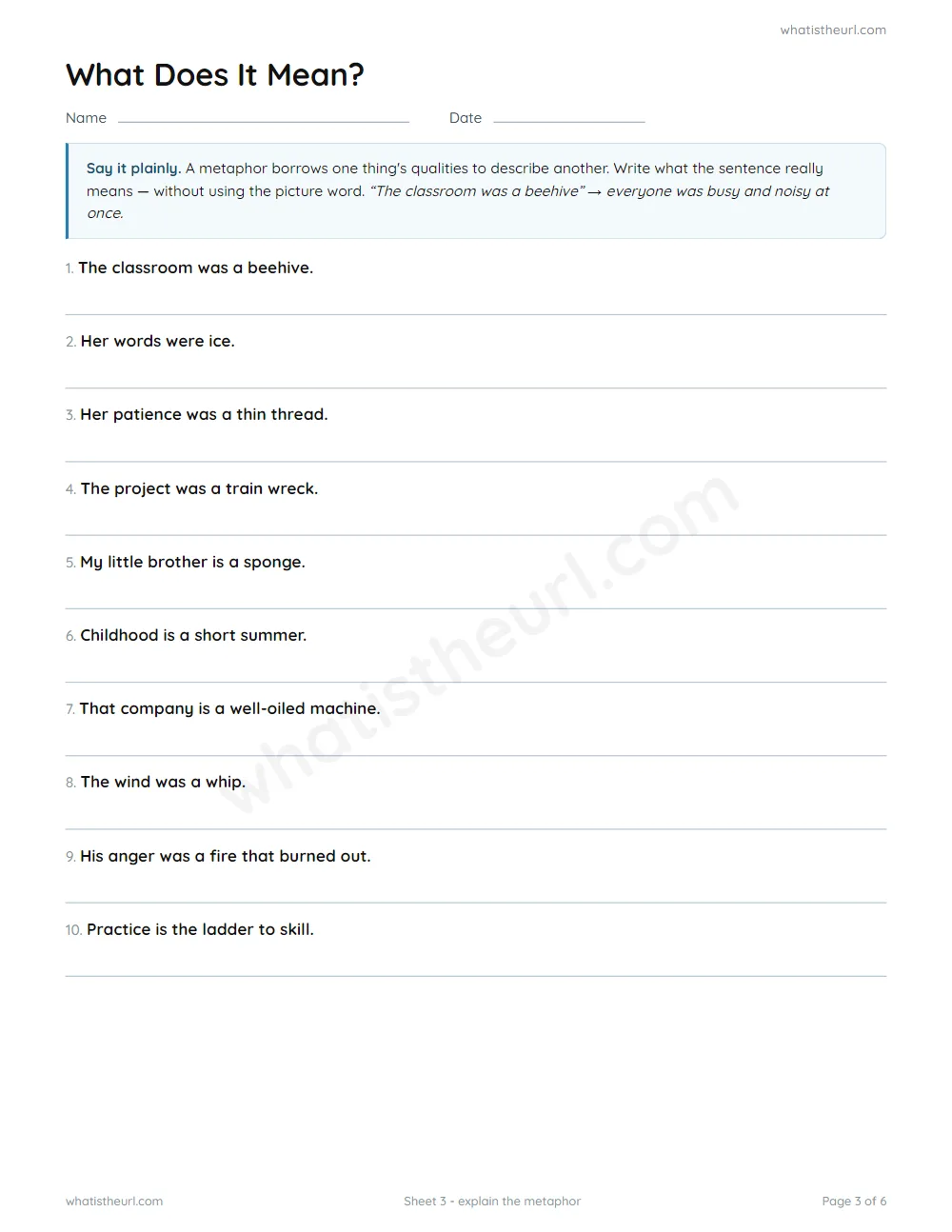
- My little brother is a sponge. He absorbs everything he hears and repeats it back.
- That salesperson is a shark. They are aggressive and circle until they get what they want.
- Her voice was velvet. Her singing was smooth, warm and easy to listen to.
Feelings and mood
- She was drowning in a sea of paperwork. She had far more work than she could cope with.
- Her words were ice. She spoke in a cold, unfriendly way.
- Her smile was a ray of sunshine. Her smile was warm and instantly lifted the mood.
- My heart was a drum. It was pounding hard and fast, usually from fear or excitement.
- He has a heart of stone. He shows no sympathy or feeling for others.
- Fear is a shadow that follows you. Fear stays with you quietly wherever you go.
- Her patience was a thin thread. She was very close to losing her temper.
- Grief is a heavy coat. Sadness weighs on you and you carry it everywhere.
Time, life and change
- Time is money. Time is valuable, so wasting it costs you something real.
- Life is a road we travel on. Life moves forward, with turns, choices and destinations.
- Childhood is a short summer. Childhood is warm and bright but over quickly.
- The years were pages turning. Time passed steadily, one part after another.
- Tomorrow is a blank page. The future is not written yet and you decide what goes on it.
- His anger was a fire that burned out. He was furious at first, then it faded.
Nature and weather
- The sky is a blanket of stars. The night sky is covered thickly and evenly with stars.
- The snow was a white carpet. The snow covered the ground smoothly and completely.
- The lake was a mirror. The water was so still it reflected everything perfectly.
- The wind was a whip. The wind was sharp and stung the skin.
- Autumn is a painter. Autumn changes the colour of everything it touches.
- The old oak is a giant. The tree is enormous and towers over everything near it.
School, work and effort
- The classroom was a beehive. Everyone was busy, moving and talking at once.
- The test was a breeze. The test was very easy.
- The project was a train wreck. The project went badly wrong in an obvious, messy way.
- The staff room was a zoo that morning. It was loud, crowded and out of control.
- That company is a well-oiled machine. Everything runs smoothly and every part does its job.
- Homework is a mountain tonight. There is a lot of it and it feels hard to get through.
- Her mind is a filing cabinet. She keeps her thoughts sorted and can find any of them.
- The library was a sanctuary. It was quiet and safe, a place to escape to.
- His excuse was a house of cards. It looked fine until one question made it collapse.
- Practice is the ladder to skill. You get good by climbing steadily, one step at a time.
How to write your own metaphor
Four steps, in order.
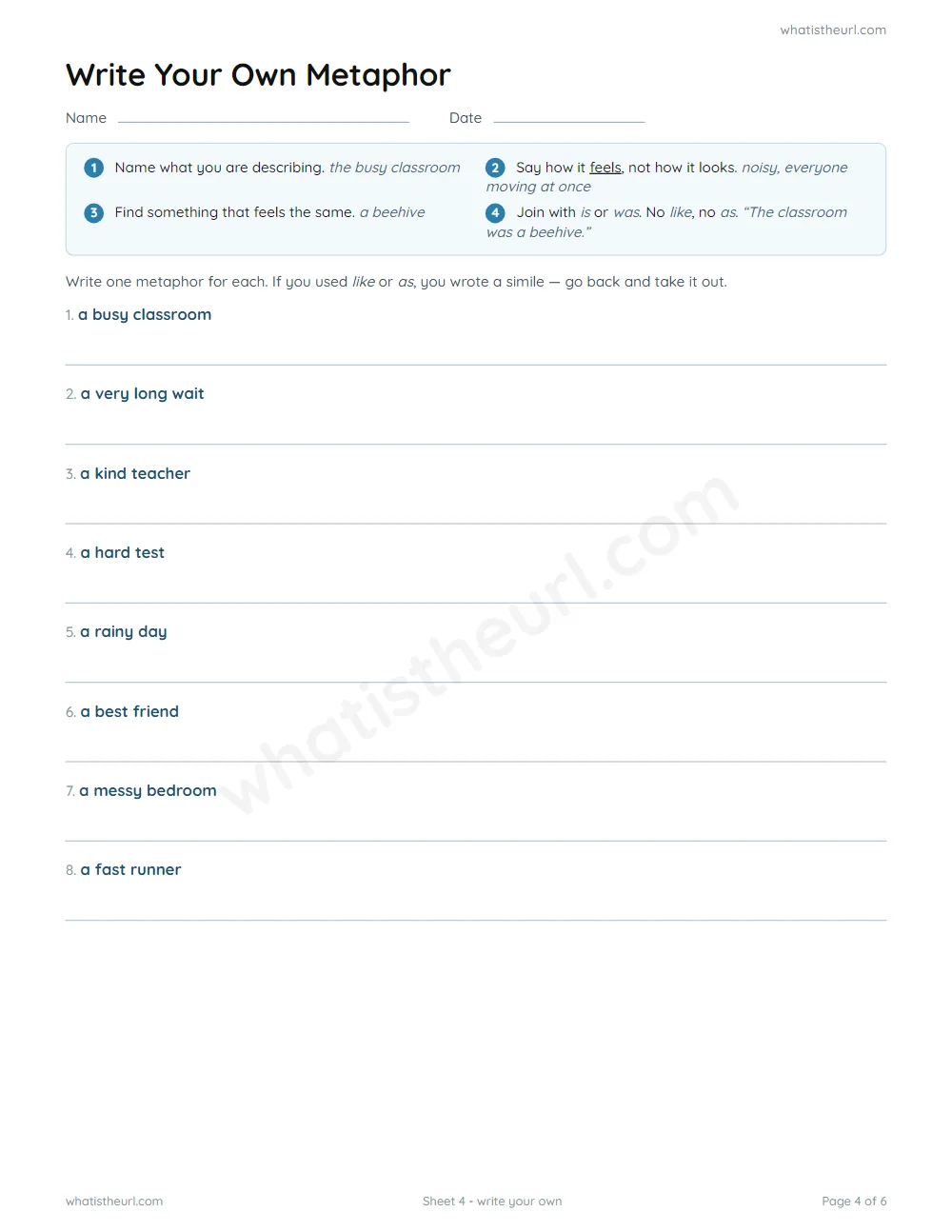
- Name the thing you are describing. — the busy classroom
- Say what it feels like, not what it looks like. — noisy, everyone moving, all at once
- Find something else that feels the same way. — a beehive
- Join them with is, was or are — and delete like and as. — "The classroom was a beehive."
If you leave like in, you have written a simile. That is not a mistake — it is just a different tool.
Is it a metaphor? A quick check
Run any sentence through these three questions in order.
- Does it use the word like or as? → It is a simile.
- Is it a fixed phrase you had to be taught, one you cannot reason out or reword? → It is an idiom.
- Does it flatly call one thing another thing, and can you work out why? → It is a metaphor.
Using these in class
The examples above are grouped by subject on purpose, because the usual exercise — "find the metaphor" — only tests spotting. These support three better tasks:
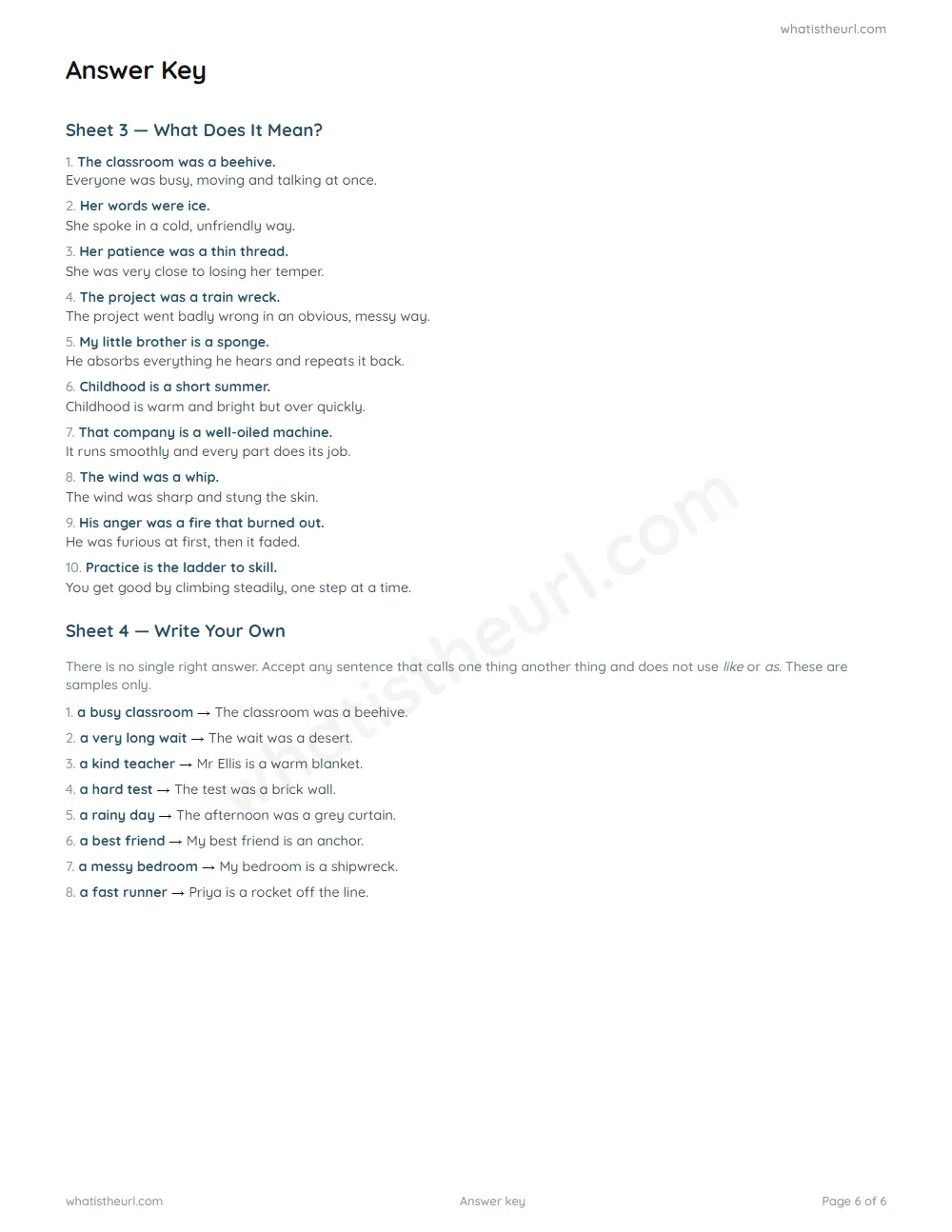
- Explain it. Give the metaphor, ask for the meaning in the student's own words. The grouped meanings above are the answer key.
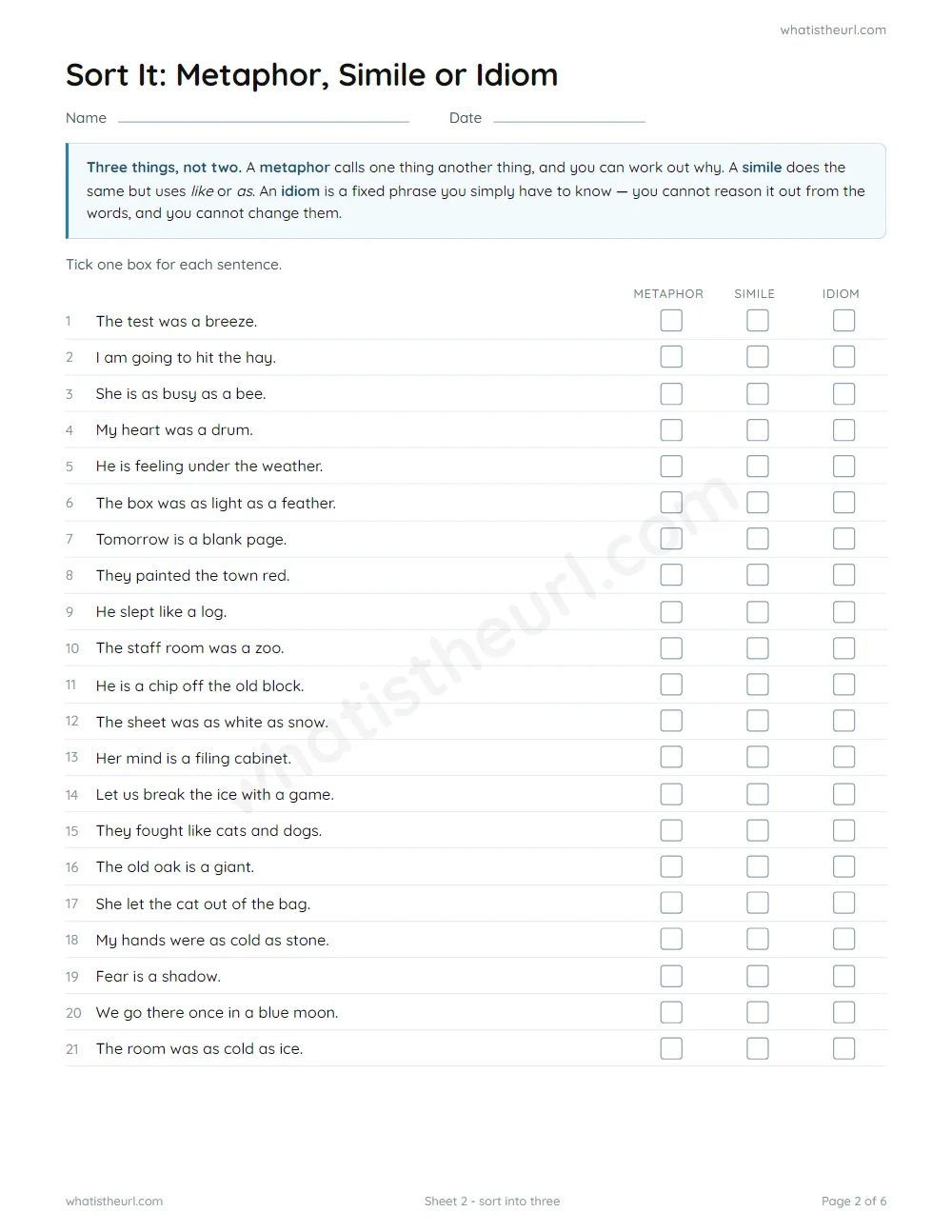
- Sort it. Mix metaphors, similes and idioms on one list and have students sort them into three columns. This is where the real learning is, and it is the distinction most lists never make.
- Build it. Give the subject only — the busy classroom, a long wait, a kind teacher — and have students write their own using the four steps.
Metaphor, Simile and Idiom Worksheets with Answer Key
Additional screenshots